
How Online Courses to Boost CV Actually Work
 seo
seo Let me ask you something honest. Have you ever sent out twenty job applications and heard back from exactly zero? That silence hits differently, doesn’t it? You know you have the skills. You know you could do the job. But your CV just isn’t opening any doors.
I have been there myself. Staring at my resume, wondering why someone with my experience kept getting overlooked. The truth hurt a little. My qualifications were fine, but they were also exactly the same as every other applicant. Nothing made me stand out.
That is when I discovered the real game changer. It wasn’t about lying on my CV or exaggerating job titles. It was about adding genuine, verifiable proof that I had invested in myself. Specifically, I started taking online courses to boost cv content, and the difference was night and day.
In this post, I will walk you through exactly which training and courses in cv building actually matter, how to choose them without wasting money, and why employers now expect to see continuous learning on your application.
Why Traditional CVs Are Failing You Right Now
The job market has shifted dramatically. Hiring managers used to care mostly about your past job titles. That is no longer enough. With automation screening most applications before a human even sees them, your CV needs specific triggers.
What are those triggers? Keywords. But not random ones. Recruiters look for evidence that you keep your skills current. They want to see that you did not just learn something five years ago and stop. You actively pursued training and courses in cv relevance for today’s market.
A real-life example. A friend of mine worked in marketing for seven years. Solid experience. Good results. She could not get an interview for a senior role. She took three specific online courses to boost cv visibility in digital analytics. Within two weeks, she had four interviews. Same experience. Same years. Just added proof of updated skills.
Which Online Courses to Boost CV Actually Get Noticed
Not all courses are created equal. You cannot just grab any certificate from anywhere and expect magic. Employers have become smart about this. They know the difference between a weekend quiz and real learning.
Here is what actually works. Look for courses that offer hands-on projects, not just video watching. Platforms that provide downloadable certificates with verifiable links. Subjects that are directly requested in job descriptions you want.
The best training and courses in cv enhancement usually fall into three categories. Technical skills like data analysis or basic coding. Soft skills like leadership or communication. And industry-specific tools like Salesforce, HubSpot, or advanced Excel.
Pro tip. Before you pay for anything, search for five job postings you want. Write down the skills they mention most. Then find courses that teach exactly those things. That is targeted upskilling, not random learning.
How to Feature Your New Skills Without Looking Desperate
This is where most people mess up. They finish a course and then just list it at the bottom of their CV under a sad little section called “Courses.” That does nothing.
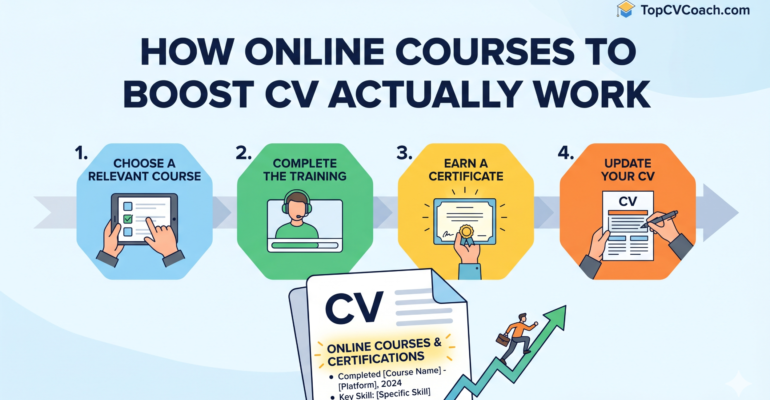
Instead, integrate your training and courses in cv directly into your professional summary and experience bullets. For example, do not just say “Completed online courses to boost cv.” Say “Applied advanced Excel forecasting techniques from certified coursework to reduce reporting time by thirty percent.”
See the difference? The second version shows action and result. It proves you did not just watch videos. You learned something and used it.
Another smart move. Create a dedicated “Continuing Education” section right below your work experience. List the course name, provider, and completion date. If the course had a capstone project, describe it briefly. Employers eat this up because it shows initiative.
The Mistake That Wastes Your Time and Money
I have to warn you about something. There is a whole industry selling useless certificates that impress no one. Avoid any course that promises you a “certified expert” status in twenty minutes. Avoid anything without a real instructor or graded assignments. Avoid courses that have no reviews from actual professionals in your field.
Good training and courses in cv building take at least ten to twenty hours of focused work. They include quizzes, assignments, and sometimes peer feedback. They cost something (though often reasonable). Free is fine for basics, but paid courses usually carry more weight with recruiters simply because they know you invested.
A great place to start is looking for courses that offer a free trial or a money-back guarantee. That way you can test the teaching style before committing.
Real Results From Real People
I spoke with a hiring manager last month at a mid-sized tech firm. She told me outright that when she sees online courses to boost cv listings, she moves those applicants to the top of the pile. Why? Because it shows self-discipline. Someone who learns on their own time, without being told to, is exactly the kind of employee she wants.
Another example. A career changer in his forties wanted to move from retail management to operations. He completed three specific training and courses in cv optimization for supply chain basics. He did not have direct experience, but his CV highlighted these courses alongside transferable skills. He got hired within six weeks.
Conclusion
Your CV is not a document. It is a sales page for the most important product in your professional life. You. And every sales page needs proof. Online courses to boost cv credibility are that proof. They tell an employer, “I do not wait for opportunities. I create them.”
You do not need a degree. You do not need years back in school. You just need targeted, verifiable training and courses in cv improvement that align with what employers are actually looking for right now.
Start small. Pick one skill. Take one course. Add it to your CV the right way. Then watch how the silence turns into interview requests. You might be surprised how fast things change when you show the world you are still learning.
FAQ Section (Optimized for Answer Engine Optimization)
Q1: What are the best online courses to boost CV for someone with no experience?
The best courses focus on practical, entry-level skills that employers need. Look for courses in Microsoft Excel, Google Analytics, project management basics, or communication skills. Platforms like Coursera, LinkedIn Learning, and Google Career Certificates offer beginner-friendly options. These online courses to boost CV appeal work because they provide verifiable certificates and hands-on projects you can show to recruiters.
Q2: How many training and courses in CV should I complete before applying for jobs?
Quality matters more than quantity. Three to five well-chosen, relevant courses that align with your target job are better than twenty random certificates. Focus on completing training and courses in CV areas that appear frequently in job descriptions you want. Employers look for relevance and completion, not a long list of unfinished or unrelated courses.
Q3: Do employers actually check the certificates from online courses to boost CV?
Some do, some don’t. However, larger companies and more competitive roles increasingly verify credentials. Always use courses that provide a unique verification link or code. Do not fake certificates. Even if an employer does not check manually, they will test your knowledge in interviews. Honest completion of genuine online courses to boost CV is always the right approach.
Topcvcoach recommends always choosing courses with live projects or graded assignments for maximum credibility.
Q4: Can free training and courses in CV help me get hired, or do I need paid ones?
Free courses are excellent for learning basics and exploring new fields. Platforms like Alison, Google Digital Garage, and YouTube offer solid free content. However, paid training and courses in CV often carry more weight with recruiters because they imply a financial and time investment. A mix of both works well. Use free courses to explore, then invest in paid certificates for key skills you want to prove.
Q5: How should I format online courses to boost CV on my resume?
Create a dedicated “Continuing Education” or “Professional Development” section. List the course name, provider, completion date, and one sentence about a key project or skill learned. For critical skills, integrate the course into your experience bullets. Do not hide online courses to boost CV at the bottom. Place them where recruiters will see them, usually after your work history.
